It’s been a long few months since finishing my tour on Sea Sheperd’s Operation Milagro. I worked on-board as a deckhand hauling in illegal nets, briefly as quartermaster on the bridge and primarily as one of a few drone operators. Here’s is Operation Milagro’s season end recap video:
During this time my dad passed away and I spent a few week back in Tucson with family. I officially left the Sea Shepherd campaign after my three month commitment ended at the end of April. At that point I needed a break to re-energize and reflect on the loss of my dad.
Since that time, I’ve been back in Tucson working on my house and volunteering again at the Arizona-Sonora Desert Museum. I’ve also been catching up with my wildlife camera-trap projects at home, the Catalina Mountains and at the Audubon’s Appleton-Whittell Research Ranch. I’ll be posting regularly now that things have settled down.
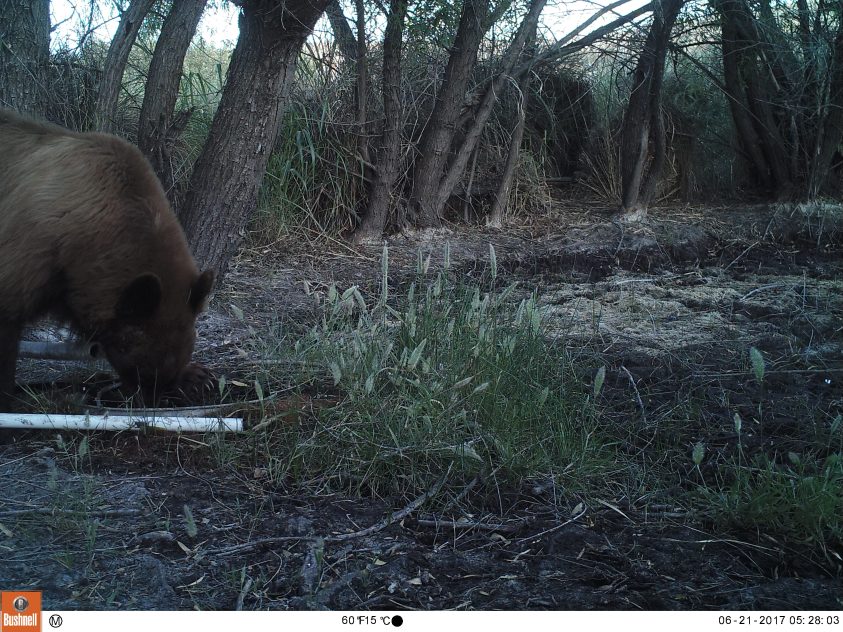
Here’s the best so far from a camera in my yard:
Here’s another mountain lion from one of my Catalina Mountain cameras:
During the first week of January I joined the Sea Shepherd Conservation Society’s (SSCS) Operation Milagro in the Sea of Cortez. Operation Milagro targets poachers who illegally set gill nets to catch totoaba, an endangered sea bass. In doing so a highly endangered porpoise, the vaquita, is often caught and drowned in the gill nets. The most recent population estimates for the vaquita place the number well below 100 individuals. The number of totoaba remaining is unknown. Our mission is to find the gill nets, pull them from the sea, destroy them and then hand them over to Mexican authorities.
Dead Totoaba pulled from an illegal net. Copyright: Greg Joder/Sea Shepherd.
Why do the local fishermen target the totoaba? Its swim bladder has purported medicinal and virility enhancement value and is sold for great profit in China.
While I can’t post the best video I’ve taken since Sea Shepherd will be using it in future videos of their own, here is a short video of interesting outtakes:
I am working on the SSCS ship named the Farley Mowat, named after the author who wrote Never Cry Wolf among other works. My primary role on the Farley is “drone pilot” and I am responsible for catching all the action from an aerial perspective not otherwise possible from the ship or a small rigid inflatable boat (RIB). My second role is that of deck crew. In this position I assist the other crew in taking aboard the illegal nets once we find them. This is difficult, back-breaking work as the nets are hundreds of meters long and are set in the shallow, current-filled northern Sea of Cortez waters by anchors that weigh nearly 150 lbs.
The anchors and bagged nets recovered in the span of two nights in the vaquita refuge. Copyright Greg Joder/Sea Shepherd.
During my first few weeks aboard the ship we have found and destroyed over twenty illegal nets and the totoaba season is just beginning. We find the submerged nets by towing a “ray” behind the ship. The ray trails a grappling hook and is designed to skim along below the waters surface and snag the net. Once a net is snagged, a line purposely snaps and the ray and a set of marker buoys is let go into the sea. In this way we can turn the ship around and relocate the buoys, and thus the net.
The Farley Mowat crew investigates a dead whale, looking for signs of entanglement. Copyright: Greg Joder/Sea Shepherd.
I recently set up a white-flash camera trap on the waterhole in my backyard. The difference between this camera and other traditional camera traps is that it uses a white-flash, just like your camera flash, to capture the photo or video of the animals when the motion sensor is triggered. Many camera traps, including several of mine, use IR, or infrared light to capture the action of the animals. Infrared light is not visible to you and me or wildlife. Because of this the camera can be triggered and the action captured without the animal being startled by seeing white light. The risk of using a white-light flash with a camera trap is that the animal will see it and run away.
Here is an example of a non-visible IR camera trap capture:
In this case, the animals were revealed by the infrared light, but they did not see any light and everything remained dark for them.
In the following video my camera used a white-light flash to capture the action. This is the same as using a flash on a DSLR in low light to catch everyone’s smiles. Since the animals can see this, it often startles them thus changing their behavior.
In my back yard it seems the animals are adjusting to the white light when they approach the waterhole:
Yes, I’m still dealing with post-election depression, facing the fact that the president elect’s views and cabinet choices will do their best to destroy nature in return for profit. A lot of damage can be done in four years. There is a lot of talk about de-regulation and fewer rules. Given that the GOP will control all three branches, it’s a no-brainer that many important and functioning environmental rules and acts will be cut or debilitated. Under the next GOP-led administration, say goodbye to the Endangered Species Act, clean air and clean water (EPA). Not to mention back-peddling on women’s rights, equal pay, pro-choice and public schools.
I despised G. W. Bush, but the next administration promises to be much much worse.
I recognize that I may lose what little viewer-ship I have by stating my opinion here, but that’s OK by me.
For those of you that stick around, thank you!
Here’s the latest… Lot’s of action at the backyard waterhole:
Dead white-tailed deer buck. Copyright: Greg Joder.
It became apparent to us that the deer had not been brought down by a predator, so we reported our find to the Research Ranch management. At this point all we know is that AZ Game and Fish is investigating. Coincident to this, my two trail cameras that were within a few-hundred meters of the dead deer were missing the SD cards. A frustrating loss of a months-worth of images/activity. Given that there is both illegal hunting and drug smuggling in the area, there’s no telling who stole the camera cards or who killed the deer.
Despite this, my other cameras on the Research Ranch captured some fun images:
Why do coyotes like to pee in a perfectly good water source? My camera caught this injured female over a month ago. She seems to be surviving so far … What do you think about wildlife peeing in good drinking water?
There have been a number of Great Purple Hairstreak Butterflies have been visiting the Desert Broom in my yard. In the following video, notice how it moves its wings as it moves over the flowers drinking nectar. Love how they look like antennae, confusing predators:
There are several Desert Broom shrubs blooming in my yard. This plant blooms in the fall, well after the monsoon wildflowers do. Like last year, I’ve been reminded that a plethora of insects love this plant:
Queen Butterfly on Desert Broom. Copyright: Greg Joder.Snout Butterfly on Desert Broom. Copyright: Greg Joder.Katydid on Desert Broom. Copyright: Greg Joder.Metalark Butterfly Species on Desert Broom. Copyright: Greg Joder.
On my way back to Tucson from Boulder I spent a day in Moab, Utah. Usually, when I pass through Moab I take a lot of photos, but this time felt compelled to capture aerial scenes. In the following video there are clips of the Wall Street climbing area (great sport and crack climbing), Negro Bill Canyon (Outstanding riparian area with lots of biodiversity and a natural arch at the end) and the Colorado River (Great flat water for SUP, kayak and rafting):